
An important instrument for the audio-psycho-phonological assessment, the listening test measures the level of clarity and precision with which the acoustic stimuli coming from the surrounding world are perceived, furnishing information on how the person perceives the cognitive-relational environment and responds to it accordingly.
At a certain point in his career, Tomatis began to ask himself whether there was a way of explaining scientifically the difference between hearing and listening, and whether it was possible to verify an individual's capacity for listening. As an expert audiologist, he was not inclined to attribute psychological implications to his patients' audiograms. Audiometry, he had been taught, was an objective science upon which subjective factors had no influence. But an experience with certain workmen exposed to intense noise made him change his mind. During his work at the French Military Aeronautical Arsenals, one of Tomatis's tasks was to examine a group of workers three times a week for several consecutive years. Observing the trend of the audiograms, he became aware that the auditory curves of some workers were changing for no apparent reason, save the hope of obtaining a disability pension on account of exposure to intense noise. "I then discovered, not without surprise," recounts Tomatis, "that an individual perfectly sincere, but secretly anxious to be considered deaf, could have his auditory threshold lowered by ten, twenty, and even thirty decibels."
"Motivated by the prospect of an indemnity, the subjects 'cheated in good faith': they obeyed, in short, psychological laws that escaped them completely. Said in other terms, subjectivity intervened equally in measurements that were claimed to be objective." Evidently, in audiometry there was something that went beyond the objective science already known. Tomatis's observation aroused new questions: how were these data to be interpreted, considering the subjective responses of the patients?
During these researches Tomatis had, moreover, observed numerous correspondences between the trend of the subjects' audiometric curves and certain behavioural data, such as fatigue. As the months passed, he also noticed connections between the auditory curves and posture, as well as a certain similarity of pathologies among subjects who presented the same auditory curve. At the same time, Tomatis was following in his practice a private clientele in his capacity as otorhinolaryngologist and phoniatrician. At this point he thought of placing the audiometric curves in relation with a whole set of problems linked to the relational and emotional sphere — vocal phenomena, postural attitudes, changes of behaviour, changes of tone, and the asthenias of which his patients often complained. All these data and their elaboration helped Tomatis to bring into focus the outline of what would become the listening test. This was happening around the middle of the 1950s. From that moment, the listening test became a valid and reliable test.
The scientist recounts in his book Vertigini (Vertigo):
A projective test, the listening test reveals the underlying psychological reactions and the tensions that provoke them. By analysing the vestibulo-cochlear responses to acoustic stimuli, it makes it possible to explain the postural counter-reactions. But the listening test, by rendering visible the responses given by a subject to sonic information, furnishes the key to his general behaviour in quite other fields: communication, language, socialisation, and so on. It is the insertion of a being into his environment that thus appeared to us.
With its sensitive-sensory-motor responses, the listening test cuts posture into "metameric slices" — that is, into successive strata linked to the different neurological stages. The low sounds are attributed to the lower part, the high sounds benefit the upper part of the body. Each slice (or metamere), with its neurological, sensory, motor and often neurovegetative responses, corresponds to an organ situated in the space pertaining to that metamere.
It became possible for Tomatis to enumerate the tonal pitches corresponding to the different metameres and, consequently, to describe with precision a tonotypic spectrum — that is, of how the sounds are distributed spatially — corresponding to the various postural and somatic levels.
The listening test furnishes, moreover, the diagram of communication. This is possible because the ear is the most important organ of verbalised relations.
If a subject decides to listen no longer, he has several means at his disposal:
- simple deafness. But it is a long and troublesome process, and therefore little used in case of urgency.
- the darkening of elective zones of auditory perception: the voice of the mother, of the father, or of other vocal spectra. The ear is capable of provoking a reduction, even an extreme one, of frequency analysis, by suppressing the clear reception of certain frequency zones — high, low, and so on. But the price to pay is high, and entails a total or partial rupture of communication. This interruption may occur in different ways. The ear suppresses certain frequencies of listening and provokes closures. It no longer analyses the sound, it no longer proceeds to frequency analysis. The result? In certain zones, auditory selectivity to this or that voice is suppressed, considerably reducing all the information that uses that same channel. The message will have only a narrow passage at its disposal, and will reach its goal only through an incredible deformation — a source of errors, of misunderstandings, and a factor of anxiety.
At the price of considerable effort and fatigue, one may sometimes produce an adhesion to sounds, but the pleasure of listening no longer exists. Few can maintain such an attention, which, moreover, will never exceed ten or fifteen minutes in an hour. In this case, it is evident that the recollection of the messages is reduced, and equally so is attention.
The ear — this antenna par excellence, this lens trained upon the surrounding environment — is therefore able to throw open its diaphragm or to close it, to insert the filters that please it, to evade its presence or, on the contrary, to increase its capacities in a particularly well-aimed zone.
The difference between hearing and listening becomes more evident. The auditory function may be performed without necessarily bringing consciousness into play. One can hear even while maintaining a passive attitude. It is a matter of the capacity to make sounds reach the central nervous system. Through an audiometric examination carried out by an ENT specialist or by an audiologist, one may measure a subject's level of hearing, so as to seek out any pathologies.
The faculty of listening presupposes a greater intervention of the field of consciousness. Listening fastens onto the auditory function, but entails an active intervention with the aim of producing a fine and detailed analysis of the acoustic information, which otherwise would reach the brain as a sonic package of ill-defined nuances.
The listening test introduces the relational dimension, which comes to condition the trend of the auditory thresholds according to the mental and relational attitude of each person — in which is evident the will to adhere, to share and to give, in short, to listen.
In order to be able to assess listening, Tomatis had to define a new series of objective criteria that were as easily observable, measurable and verifiable as those used in the audiometric examination.
Knowing that the human ear has the capacity to perform, normally, the following functions:
- To perceive sounds
- To process sounds without distortion
- To distinguish high sounds and low sounds
- To perceive the spatial origin of sounds
- To pay attention to the sounds one wishes to listen to and to avoid those one does not wish to listen to
- To transmit energy to the brain through the nervous signal created by sound (cortical recharge)
- To integrate and co-ordinate the information coming from the muscles
- To maintain balance and the relationship with gravity
- To stimulate and maintain neurovegetative balance
- To control phonation
- To control musical ability
The listening test furnishes a comparison of the person's listening with an ideal, well-functioning ear, based upon the following requirements:
- A threshold of audibility within the norm
- An open auditory selectivity for the analysis and comparison of sounds, so as to determine their difference from one another and the direction of that difference (higher tones–lower tones)
- A precise spatialisation of sounds for the identification of the sound source
- An ascending listening curve up to 3000–4000 Hz, with a stabilisation at this level and a slight fall in the higher frequencies, so as to permit an easier discrimination among sounds
- A greater attention to the sounds one wishes to listen to than to the rest
- A uniformity of reception and an absence of distortion in the response curve of the ear
- A balance between bone conduction and air conduction in each ear and between the two ears
- A right audio-vocal dominance for a neurologically efficient control of the analysis of sound, directly from the right ear to the language centre of the left hemisphere
- An effective vestibular integration of muscular and sensory information for an effective motor control
- Perception of high sounds to energise and to keep the brain stimulated
The listening test therefore comprises a series of examinations carried out with an audiometer calibrated according to norms perfected by Tomatis. The perceptual thresholds obtained refer back to the natural curve of the ear — that is, to the true thresholds of perceptual sensitivity at the various frequencies. The audiometric curve is a linear straightening of the natural curve, for reasons of ease of reading. In Tomatis's listening test the curves are therefore not flat; they present an ascent of about 6 decibels per octave up to 2000 Hertz, a dome between 2000 and 4000 Hertz, and then a slight descent in the higher sounds that follow.
The parameters whose measurement is sought with the listening test will be:
- The thresholds of minimal audibility for air conduction, or perception through the auditory canal by means of headphones, and the thresholds of minimal audibility for bone conduction, by means of a vibrator placed against the mastoid bone. It is a matter of finding, for each frequency, the faintest sound that the subject manages to perceive. The volume is increased progressively, in increments of 5 decibels, until the patient signals that he has heard. Contrary to the protocol of classical audiometry, the sound is not repeated if the subject has not heard it. The listening test has the aim of measuring "conscious attention" by simulating what happens in life; for this reason the patient is not excessively solicited to pay attention to the arrival of the sound.
- The spatialisation of the sound — that is, the subject's capacity to identify in space the provenance of the sonic information
- Selectivity. This examination measures the subject's capacity to discriminate the differences of tone among the various sounds (lower or higher), and consequently the degree of clarity with which the sounds are perceived
- The laterality of listening makes it possible to identify which of the two ears manages the neurological control of the sound, for an efficient control of listening and of phonation. We know that the right-ear circuit is shorter than the left, and consequently the integration of sound and the control of phonation are more effective on this side.
The curves and measurements thus obtained are placed in relation with the ideal reference test, in order to carry out an interpretative reading of the subject's listening.
Air conduction is indicated by a blue line, or by a continuous line, while bone conduction is indicated by a red line, or by a dotted line.
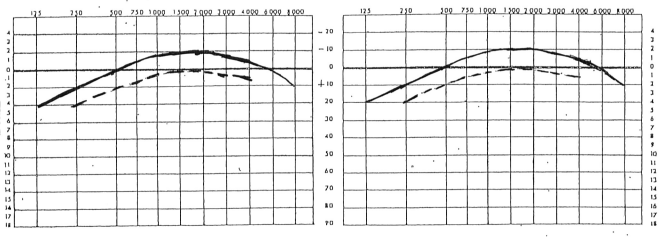
Figure 1. Ideal listening test
Tomatis then divides the listening test into three zones, as indicated in figure 2.
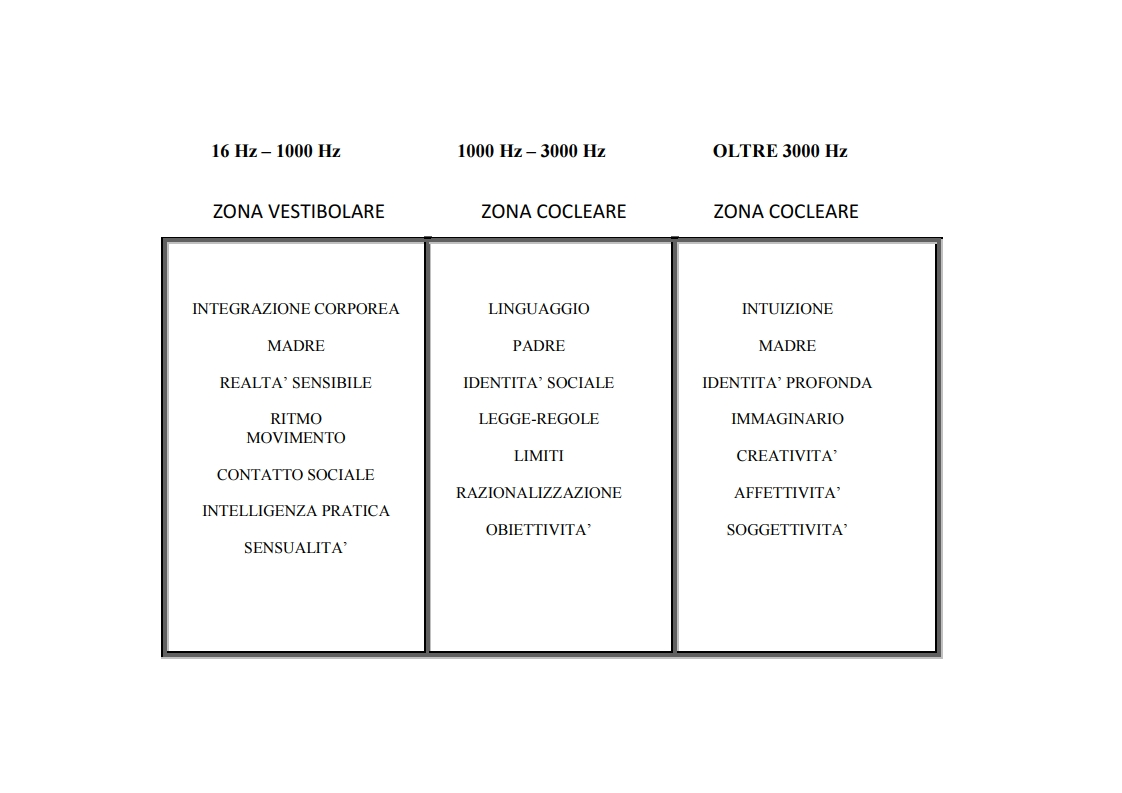
Figure 2. Division of the listening test into three macro-zones. Zone 1, from 16 to 1000 Hz: the zone of the body. Zone 2, from 1000 to 3000 Hz: the zone of language and of rationality. Zone 3, from 3000 Hz up to the highest audible extremes: the zone of cortical recharge, of creativity, of spirituality (in the broad sense).
The three zones, though distinct, are complementary to one another.
Zone 1, which goes from about 16 Hz to about 1000 Hz, is called the zone of the body. It is the zone of greatest response on the part of the vestibule to sounds. It is linked to the body, to movement, to practical sense and to the somatisation of emotions.
Zone 2, from about 1000 Hz to about 3000 Hz, is called the zone of language, of communication and of rationality. It is the zone where the human ear is most sensitive, when one has no auditory problems or listening problems. This greater sensitivity allows the nervous system to have an optimal control over language and, in cascade, over all the functions that support it: attention, concentration, memory, reading, writing, and so on. A listening disturbance in this zone may favour problems of attention, concentration, reading and intonation.
Zone 3, from about 3000 Hz upwards to the highest perceptible extreme, is called the zone of cortical recharge, of intuition, of creativity, of spirituality (in the broad sense). It is the zone of frequencies that gives the greatest electrical-nervous stimulus to the nervous system in general and to the cortex in particular, favouring its activities of synthesis, abstraction, creativity, sublimation, rapid elaboration of conflicts, and so on.
Reading the listening test
The reading of the listening test is done taking account of the division just outlined, and following certain guidelines, of which we indicate below the most important, referring any further study to more specialised texts:
Air conduction, which represents perception through the auditory canal and the eardrum, is conscious perception. It translates the social life of the person. It informs us of the efforts of adaptation in the face of the world, and of the manner in which the person organises his communication with the surrounding environment. This curve corresponds to the activity of the middle ear. From a general point of view, it shows what the person exteriorises in his communicative and relational life.
Bone conduction represents perception through the body. Of this we are not conscious. It translates the inner life and furnishes indications on the body and on the manner of organic functioning of the person. It corresponds to the inner ear. In a very general manner, it is linked to the internal tensions of the person.
Spatialisation indicates the capacity to localise sounds in space and to understand their provenance. It is important for the orientation of the person in space and in time. It is important in concentration. We localise sounds by using the differences of time and of intensity that reach our right ear and our left ear. The presence of errors of spatialisation in the listening test may be indicative of a neurological confusion in the management of these two structures, so very important for daily living, with negative effects upon concentration — above all if the errors are localised in the zone of language. Errors of spatialisation in zone 3 might indicate affective indecision, or difficulty in trusting one's own intuitions and consequently in using one's own creative potential. Their presence in zone 1 might indicate problems in geometry, rhythm and motor dyspraxia.
The laterality of listening tells us which ear is used to focus the sounds that must be analysed by the cerebral zone of the left hemisphere appointed to that purpose. The right ear, connected in a more direct and rapid manner with the left hemisphere, furnishes the physiologically most economical and effective solution to that purpose. The left ear performs the role of controller of operativity, thanks to its more direct connection with the right hemisphere.
It is important to know that the listening test is the instrument that gives the therapist the indications for the programming of the Electronic Ear. When it is not possible to carry it out, on account of the subject's too young age or for want of co-operation owing to particular pathologies, one uses the information coming from the case-history data, from observation and from any other tests.
A fuller description and more detailed explanations of the parameters measured by the test, and of their connections with the cognitive and relational life of the individual, may be found in many of Tomatis's books and in specific texts on the subject of forthcoming composition.