
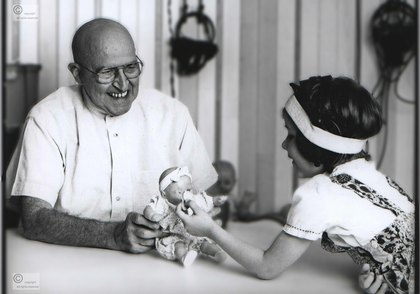
Thus wrote Alfred Tomatis in 1977, in the first edition of his autobiography L'orecchio e la vita (The Ear and Life), on page 319:
"I have been much copied, much plundered, yet no bitterness comes to me from it. I would go so far as to say that, if the counterfeiting of the machines I have perfected made it possible to heal more patients, I should be the first to rejoice.
What troubles me, what saddens me, is that most of the counterfeiters are not content to exploit the ideas of others; they wish to make the world believe that they are people of genius — like a painter who, wishing to plagiarise the Mona Lisa, would add to her a great hat and an umbrella because, in his opinion, "they suit her". In general, my pickpockets toil in vain: recording few therapeutic successes, they have not made their fortune. The expression of this sort of immanent justice is explained, once again, by the want of modesty of these forgers, who have not known how to limit themselves to reproducing the model as it stands. Certain that they are far cleverer than the inventor himself, they have wished to beat him on his own ground. Each time, it is this desire for "improvement", founded upon ignorance of psychophysiological realities, that brings about their defeat."
More and more people write to us to ask for clarification as to what the Tomatis method is, how it ought to be applied, and why one finds on the web the sites of companies or professional practices using techniques called "Tomatis" whose contents are often at variance with one another, or in certain cases incomplete. The greatest confusion for our correspondents comes above all from the sites that promise to teach the "true" Tomatis method, often in one, two or three weekends of "training".
It is important to know that, upon Tomatis's death, the training institute he had directed — which, during his lifetime, was the guarantor of the correct application of the method he had perfected over forty years of research — was taken over by a commercial company directed by one of Tomatis's sons. This company, doubtless wishing to prove that it could do better than its founder, dismissed most of Tomatis's closest collaborators, with an immense loss of people of great clinical, technical and scientific experience in the field of audio-psycho-phonology. The school was given a radically different orientation, both in the application of the method and in the training of new therapists. The very management of the institute suffered financially, which led to its judicial liquidation.
From that moment — it was 1997 — most of the Italian and foreign centres decided to have no further dealings with the institute, while remaining nonetheless in close relationship and continuous contact with Alfred Tomatis until his death on 25 December 2001. The strongest repercussions were felt in France, where eighty per cent of the centres closed for good. In spite of this, most countries managed to continue dispensing the theoretical and practical heritage of the pedagogy of listening in an autonomous manner. Associations and schools, founded by pupils of Tomatis, have been able to ensure, year by year, the training of new listening therapists and to encourage the opening of new centres.
The Tomatis method according to Alfred Tomatis
Tomatis laid down precise rules as to how his method must be applied, and he transmitted these rules to his pupils during the training courses he held in Paris at the institute he had founded. His pupils, in their turn, transmitted these rules to their own pupils. Tomatis wrote a dozen books on his method and its applications, and there exist dozens upon dozens of scientific articles written by him, together with the texts of his lessons and of conferences given at various training bodies, schools and universities throughout the world. A certain number of these conferences and lessons may be downloaded in PDF format from the page Scientific articles, texts of conferences, lessons and more of this site.
The correct way of applying the Tomatis method (according to Alfred Tomatis and his pupils) presents the following fixed points:
- There are no progressive levels in the application of the Tomatis method, such as those proposed by certain commercial companies that promote rapid training courses for the use of equipment they themselves sell or lease. The method is one, and follows a manner of application as indicated in Tomatis's book L'orecchio e la vita. In the true Tomatis method there are no therapists of differing levels, authorised to bring their patients only up to a certain point of the journey, after which, in order to continue the therapy, the patients are obliged to turn to a therapist of a higher level, or to wait until their therapist continues his training so as to reach the next level of preparation. Listening therapy with the Tomatis method is linear; it does not follow a fragmented course, broken up by the instalments of the therapist's own training.
- The second point is a deepening of the first, with further specifications. Although there are variations in the programme according to the field of application (dyslexia, singing, languages, pregnancy…), the audio-psycho-phonological course nonetheless follows, save for particular indications, the path of the progressive high-pass filtering towards the high frequencies (RSM) up to the 8000 Hz filter, in order to accustom the ear to the subsequent phase, called that of the Filtered Sounds (FS), which represent the first acoustic imprint received, from which language will develop. The phase of the Filtered Sounds is, for Tomatis, very important for the success of the subsequent phases. This phase is followed by the Sonic Birth, which flows into the Pre-language phase and then into the Language phase. In the musical field (voice and instrument) the Sonic Birth is not carried out; once the filtered sounds are reached, the practical work with the voice or the instrument begins to be introduced through the cybernetic control of the Electronic Ear. The Tomatis method, as an audio-psycho-phonological course — that is, a training that makes it possible to retrace the stages of the development of the subject's listening so as to allow him to open frequency gates that did not open in their time, or to reopen others that have since closed — is described by Tomatis in unequivocal terms in his scientific autobiography L'orecchio e la vita, in chapter VII: "The method I recommend is simple in its principles. It is a matter of having the patient travel through, by means of a conditioning, the ideal sonic progression from which, for reasons x, y or z, he has strayed too far. Having determined which acoustic evolution was most favourable to the development of the subject's personality, it was not too difficult for me to have the subject live through it, thanks to the use of the electronic apparatus and to a certain number of specific adjustments. The different phases that characterise the ideal itinerary are recreated in the laboratory. Without entering into detail, one may distinguish five principal stages that succeed one another, whose names have no other value than that relative to the use made of them, in France and abroad, by the users of the Electronic Ear:
- sonic return;
- filtered sounds;
- sonic birth;
- pre-linguistic phase;
- structuring of language."
- We come to the third cardinal point of the Tomatis method: by what means can the listening therapist, at the patient's first audio-psycho-phonological assessment, understand how far the patient has strayed from the ideal sonic progression? He does so through the use of the listening test, the foremost instrument of the re-education of listening. It is thus described by Tomatis in his book Vertigini (Vertigo): "A projective test, the listening test reveals the underlying psychological reactions and the tensions that provoke them. By analysing the vestibulo-cochlear responses to acoustic stimuli, it makes it possible to explain the postural counter-reactions. But the listening test, by rendering visible the responses given by a subject to sonic information, furnishes the key to his general behaviour in quite other fields: communication, language, socialisation, and so on. It is the insertion of a being into his environment that thus appeared to us." The Tomatis therapist always carries out a listening test before having the user begin a course with the method. The listening test is omitted only in those cases where it is objectively impossible to carry it out for want of co-operation (children too young, or significant neurological, psychological and motor difficulties). The test is a valuable aid in obtaining a clear picture of the subject's listening, and in being able to set up accordingly an appropriate programming of the Electronic Ear and of its sonic supports. It is, moreover, administered in the course of the therapy in order to assess its progress. In many of Tomatis's texts one may find fuller information on how Tomatis perfected the listening test and on the manner of its administration — among the many, Vertigini and Educazione e Dislessia (Education and Dyslexia).
- A fourth factor that makes it possible to recognise the audio-psycho-phonological method as it was perfected by Alfred Tomatis is the mechanism of the rocker, or gating, of the Electronic Ear. Understanding it makes it easier to recognise any counterfeits passed off as the true gating of the Electronic Ear. The gating is a physiological mechanism which, having discovered it, Tomatis succeeded in incorporating into his apparatus in order to render permanent the effects of his re-education.
It consists in passing the sonic message one is listening to through the Electronic Ear alternately through two channels of amplification, regulated in such a way that the first sets the ear at rest — that is, without its necessarily paying attention to what it is hearing — while the second channel is regulated in such a way as to help the ear to "tense itself" so as to focus the sounds and consequently to pay attention to them.
This mechanism electronically mimics the physiological action of the human ear when it passes from merely hearing sounds passively to listening — that is, to bringing into focus the information that interests it and leaving in the background the rest of the acoustic information present in the environment.
Tomatis explains that, in the human ear, when it is in a passive auditory attitude and therefore not listening, the two small muscles of the middle ear — the tensor tympani muscle and the stapedius muscle — are in a state of release. In this mode the ear hears but does not listen; it is without any accommodation.
The moment the person, voluntarily or automatically, decides to listen — because stimulated to do so by an incoming sonic message — the two muscles (first the stapedius and, after a certain number of milliseconds, which vary from one language to another, the tensor tympani) tense themselves so as to allow the accommodation of the ear to the sounds that interest it and, at the same time, to favour an optimal analysis of them.
All this is mimicked in a precise and targeted manner by the Electronic Ear, through the passage of the sound from a channel of amplification which — by enhancing the low frequencies and appreciably attenuating the high frequencies — allows the ear to be at its point of non-accommodation, that is, of non-listening, of mere hearing, to a second channel of amplification which — by attenuating the low frequencies and appreciably enhancing the high frequencies — solicits the ear to aim at the sounds, to listen.
The continuous passage from the first channel to the second channel makes it possible to train the ear, so as to accustom it then to accommodate spontaneously to the sounds and voices of the living environment (language, school, work, affections, music, foreign languages…).
The gating of the Electronic Ear was conceived by Tomatis in such a way that the passage from the channel of rest to the channel of auditory attention occurs upon the reaching of a determined volume of the sonic signal. This is in order to favour the innate physiological attitude of the human ear, which begins to pay attention upon the reaching of a certain threshold of sonic volume. The return of the sonic message to the channel of rest occurs when the volume falls back below the threshold of the attention volume set for the machine.
It is important that both the persons who undergo the Tomatis sessions and the aspiring therapists of the Tomatis method should know the importance of this, and should verify that the equipment used for the therapy respects this criterion.
We stress this because there have recently been noted in circulation pieces of equipment that do not respect the criterion of the reaching of a determined volume for the triggering of the gating from Channel 1 to Channel 2. This is anti-physiological and consequently harmful. If all goes well, one may obtain provisional effects of well-being, but they are not lasting, nor so profound as those obtained with Tomatis's precession Electronic Ear (Alfred Tomatis). Above all, one risks disorienting the ear in its manner of activating listening and attention, and, in cascade, all the functions that depend upon it.
The fifth point, no less important than the foregoing, concerns the equipment — namely the Electronic Ear, the musical supports and the players of these musical supports. This subject requires certain important clarifications, principally regarding the difference between analogue and digital, and as to what may be digital and what must be analogue in the Tomatis sessions. Contradictory and confused information is to be found on the internet, and this, unfortunately, according to the type of equipment that one company or another decides to sell on the market represented by the future audio-psycho-phonologist therapists.
Let us make clear that the sound source may be digital, of high quality. By now most people listen to digital music. The musical supports are by now almost exclusively digital. To this imperative of the market the Tomatis method responds with high-quality digital sound sources. The human ear that processes this information, however, works and will always work in analogue. Human physiology is not digital. It works in analogue sequence. What enters at the input is returned at the output in real time, without losses or delays due to the "unpacking" of the information into numerical form for digitalisation, and to the subsequent repacking for the reconversion of the numerical form into an analogue signal. The Electronic Ear — as anyone with experience of the Tomatis method knows perfectly well — is the simulation of a perfect ear that knows how to listen. In order to obtain the best re-educative effect, it is obliged to respect the timing and the physiology of the human ear. This can best occur in analogue mode. Digitalisation, a technological innovation of vast scope, is excellent for packing and translating data into numbers, thereby facilitating their processing, transmission, and so forth. This has undoubtedly permitted notable advances in the sciences and in technology. When, however, one works on a therapeutic plane at a fine level, in order to re-establish psychophysiological rhythms that have lost their normal flow, one must take account of the requirements of the nervous system, which, as Tomatis used to say, has not followed and does not follow the same processes of progress as technology. The therapeutic advantages of the use of an analogue electronic ear are manifold, and cannot be replaced by a digital electronic ear:
- The bandwidth is extremely wide, which means that all sounds of any kind whatsoever, whatever their frequencies, applied at the input of the machine, will be found again at the output. There will be no loss of energy, nor of information.
- The dynamics of the gating are in real time. The whole process being analogue, it will be close to the physiological behaviour of the human ear. The analogue gating creates a passage from mode 1 of listening to mode 2 in a manner that is not abrupt, without assailing the ear. It may seem superfluous to say what we are about to say, but it is important that the gating effect should not be pre-recorded. This is anti-physiological. We have had occasion to hear super-compact devices, the size of an iPod, declared to be for the Tomatis method, in which the passage from Channel 1 to Channel 2 occurred independently of the reaching of the gating threshold by the volume of the musical piece. Anyone who has attained a fair knowledge and practical experience of the Tomatis method knows perfectly well that this is anti-physiological and counter-productive for the good progress of the therapy. The ear in nature is solicited to listen when the signal reaches a certain volume. I turn round when someone calls me, if his voice has reached a sufficient volume for me not only to hear it but to understand that he is addressing me — thanks to the activation of my middle ear, which will allow me to pass from mere hearing to listening, and consequently to recognition.
- To remain on the pre-recorded gating: granting that it has been pre-recorded while respecting the response parameters of a true electronic ear, it will, after a few listenings of the same piece, no longer permit the effect of surprise given by the randomness of the gating, thereby reducing the effect of the re-education. The unpredictability of the moment of the gating is one of the important factors for the good success of the re-education of listening.
- Further: in the audio-vocal work in a closed circuit with microphone–electronic ear–headphones, the precision of the gating times is very important — for bone conduction first and for air conduction afterwards (Delay and Precession) — in order to train the audio-vocal circuit correctly, for example on the rhythms of the various foreign languages, which vary from one language to another by a few milliseconds, important for the attainment of the correct linguistic accent. Still more in this case, the digital circuit risks rendering the gating times less precise. An episode in this regard befell us some years ago. We had been invited, some years ago, together with other European colleagues, to collaborate with an emerging trainer in the Tomatis method, who — as we discovered later — had as his aim, rather than the transmission of the method, the sale of digital equipment of his own manufacture, claiming to have had Tomatis's approval. It was in reality a crude imitation of the Electronic Ear, "improved", in his view, thanks to the addition of certain buttons-functions which, according to what he verbally declared, were supposed to represent a sort of "advancement" of the therapeutic properties of Tomatis's original Electronic Ear. The acid test of the machine came, for us and for our European colleagues, when we tried to have a pupil pronounce a foreign language through the circuit of this machine, regulated according to the parameters of that language: impossible. The Delay and the Precession, not corresponding to the milliseconds established by Tomatis, did not permit a correct accent of the language, while the regulation of the envelope curve on Channel 2, not conforming to the regulations of the envelope curves of the Electronic Ear, did not permit one to find the correct sonority for that language.
If necessary, upon request, for anyone who should have need of it, fuller information may be furnished on the difference between the analogue Electronic Ear and the digital Electronic Ear.
Let us recall what Alfred Tomatis wrote in 1994 concerning the Electronic Ear:
"The Electronic Ear that we use in the field of Audio-Psycho-Phonology is an apparatus with analogue processing.
This device corresponds to certain operational requirements of the human ear in its mechanisms of listening. It is suited to transmitting the sound to the cortex, and thence to the whole body, through certain networks that I have called the 'integrators'.
This set of integrators functions on an analogue rhythm, which corresponds to the neurophysiological responses of the organism. It is therefore necessary to know that, as part of our therapeutic action, one may use only a set of devices (electronic ears, headsets, microphones, and so on) that operate in analogue mode. This is in order to ensure a maximal cortical recharge.
On the therapeutic plane, it is necessary to take account of the requirements of the nervous system, which has not followed the same changes that present-day technology has undergone. The brain must be considered as a gigantic network whose purpose is to place all the cells in contact with one another, so that they may act in unison — in accordance, of course, with their own attributions, which individualise them within a functional programme."
………………………………………………………………………………………….
The pupils of Tomatis learned the rules of the art directly from the inventor of the method, and they apply them in their professional practice so as to make the method work. At the same time they transmit them to their own pupils in the training courses held in the various countries.
The therapists of the Tomatis method, distributed throughout the world, obtain no better knowledge when they buy the rights to display a certain brand-logo on their site or in their informational brochures. They simply pay the rights for the use of the brand-logo. They do not pay the rights to work with the Tomatis method. The method is in the public domain. It is certain that, in order to apply it, one must learn it, following the rules perfected by Tomatis. And the equipment must respect the criteria of construction established by Tomatis. It must be clearly pointed out that at present no institution or organisation holds the exclusive rights to the Tomatis method. Dr Tomatis deliberately brought his method into the public domain. Therefore, no one may collect licence fees for granting the right to use this therapeutic method, nor claim exclusive rights in the field of training. We never cease to suggest to the potential beneficiaries of the method, and to the aspiring therapists, that they read carefully and attentively what is written on the various sites that propose the Tomatis re-education or the training of future therapists. A registered trademark protects the mark itself, not the corpus of knowledge. If I wish to use a trademark, I pay the licence fee for the use of the mark. This is correct. It is, however, a sort of label that I may attach to a product — a product that may be interchangeable at the discretion of the owner of the mark.