
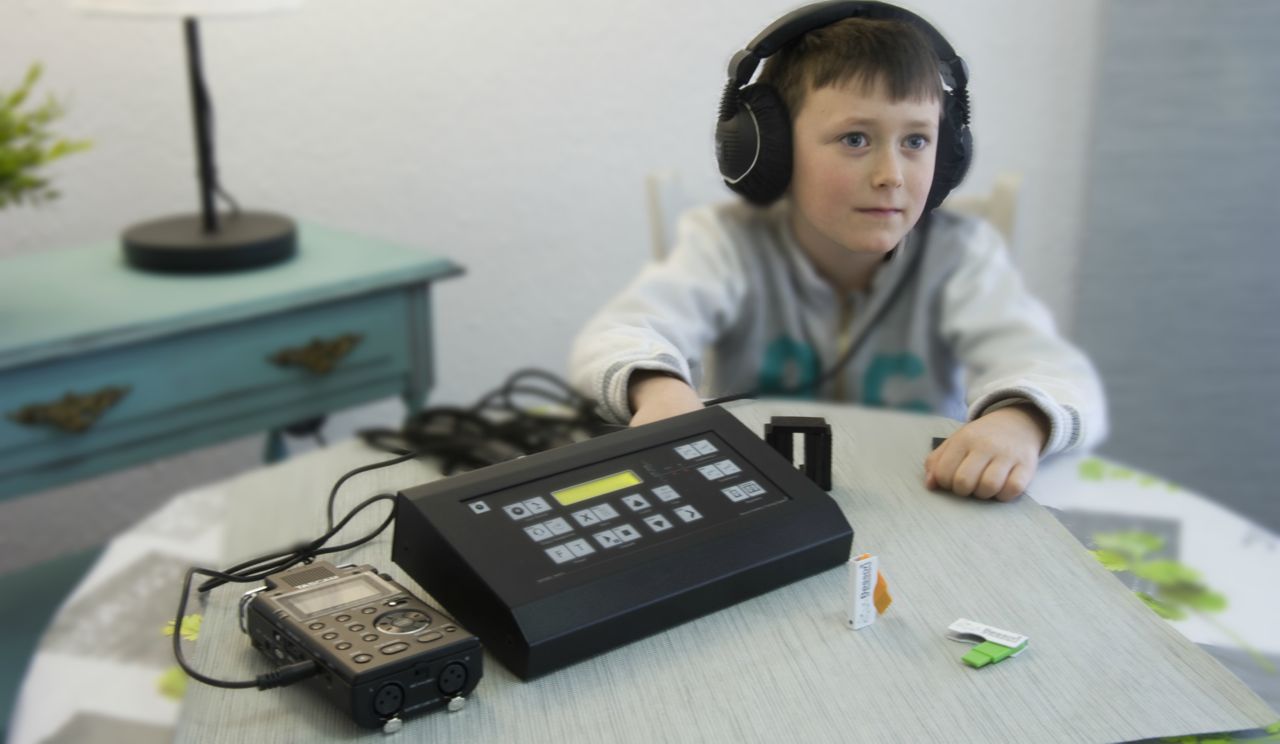
Basic principles of the functioning of the electronic ear with Tomatis effect
It all begins more than fifty years ago, from the comparison of two series of observations. As an otorhinolaryngologist and the son of an opera singer, Tomatis found himself treating many artists with ruined voices. In the same period, however, Tomatis was directing the Acoustics Laboratories of the French Air Force, where he had to examine the people whose hearing had been impaired while working at the test benches of the supersonic reactors, in order to know whether they ought to be indemnified. Together with the acoustic damage, Tomatis very often observed a very marked deformation of the voice, and he asked himself whether the damaged hearing might not be the cause of the voice problems — even in the case of the singers, in whom the acoustic damage might have been caused by their own voice, used at high volume in an inappropriate acoustic environment.
Deepening his observations, Tomatis was struck by the parallelism existing between the audiometric examination of the subjects examined and the envelope curve of the spectral analysis of their voice: he then began a series of experiments bearing upon the reactions and counter-reactions of hearing upon vocal emission. To do this he used two set-ups:
– one that made it possible to visualise the harmonic decomposition of the sounds emitted (spectral analysis), through the use of a microphone and an analyser.
– the other, which gave the possibility of modifying at will the listening of the subject taking part in the experiment; his voice was captured by a second microphone connected to an amplifier whose response characteristics at the level of the headset worn by the subject could be modified thanks to a play of filters (high-pass / low-pass / band-pass), thus making it possible to vary the subject's manner of listening and consequently his manner of controlling himself.
The extraordinary importance of the counter-reactions that manifested themselves in the experiment authorised Tomatis to affirm that there exists a veritable closed circuit of self-information, whose control sensor, at the moment of emission at the level of the phonatory apparatus, is none other than the ear, and that every modification imposed upon this sensor produces instantaneously a considerable modification of the vocal act — easy to observe at the visual and auditory level, and physically verifiable on the cathode tube of the analyser.
Thus, it being established that a vocalic expressive mode linked to a conditioning of the phonatory apparatus, exteriorising itself through a known vocal act, responds to a manner of listening determined by a more or less complex conditioning of the whole of the auditory apparatus; it being established, moreover, that every modification of this manner of listening generates a new vocal act, Tomatis then tried to modify the faulty conditioning with a new conditioning, calculated on the basis of an ideal listening curve (that of a great professional of the voice, for example).
From the very first sessions, it is observed that a temporary remanence of this new state subsists, and after a certain period of training, it becomes permanent.
To realise this process in practice, Tomatis perfected an apparatus that would be called the Electronic Ear with Tomatis Effect.
The four fundamental laws of Tomatis
Raoul Husson, taking up this experiment again in 1957 in the Laboratories of the Physiology of Functions at the Sorbonne, confirmed it entirely, and grouped this set of audio-phonatory counter-reactions under the name of the Tomatis Effect.
This is defined by four laws:
The voice contains what the ear perceives.
If one restores to the traumatised ear the possibility of listening correctly to the poorly perceived frequencies, these are found re-established in the phonatory emission, instantaneously and unbeknown to the subject.
Generalising this audio-phonatory relationship to a normal ear:
The ear transmits to the phonatory apparatus the auditory modifications artificially imposed upon it.
Tomatis, having posed himself the question of knowing how the ear could conserve the benefit of this exercise and improve progressively, arrives at the fourth law:
Forced listening, alternately imposed and suppressed, comes to modify permanently both listening and phonation.
The electronic ear and its mode of action
This apparatus is an electronic complex comprising amplifiers, filters and a play of electronic gates. It may be used in two modes:
1. The information transmitted by a tape recorder passes through the E.E. before reaching the subject's ear by means of a headset (purely auditory training).
2. The information transmitted by the tape recorder is perceived and reproduced by the subject during the sonic blanks distributed across the magnetic tape: the pupil's voice is captured by a microphone, modified by the E.E. and returned to the headset in real time (audio-vocal training).
The E.E. acts by shaping the information within a determined passband, in order to suppress the scotomas (falls of the listening curve at certain frequencies) and to give the curve the necessary progression (ascending slope) for a perception and a frequency analysis of optimal quality.
It also offers the sonic message two possible paths: one channel corresponds to the setting under tension of the eardrum and of the muscles of the hammer and of the stirrup, another acts upon their relaxation; a simple regulation is then necessary to pass the information alternately from one channel to the other, thus provoking a continuous movement of tension and relaxation of the adaptive muscular mechanisms of the middle ear.
This micro-gymnastics, prolonged for a certain time, produces a phenomenon of remanence that creates a progressive and permanent muscular conditioning: the middle ear thus becomes capable of carrying out by itself, spontaneously and correctly, the regulations necessary for the transmission of sounds.
These various functions are ensured by certain electronic ensembles:
The filters: distributed over two levels, they form the two channels and modulate the passage of the frequencies (one, for example, may let the high frequencies pass preferentially, and the other the low frequencies).
The gate: it regulates the successive comings and goings from one channel to the other; it is a sort of door that opens and closes according to the variations of intensity of the sonic message.
The balance: in order to prepare the right ear to become the director, the ratio of the sonic intensities, corresponding to the two earpieces of the headset, is progressively differentiated by a reduction of the intensity on the left.
As regards the sonic information properly so called, it is constituted by a set of magnetic tapes recorded in the laboratory, whose order of diffusion is determined by the programme conceived according to the case being treated; it consists essentially of music and of the human voice, eventually processed electronically — in practice, more or less filtered at certain frequencies.
The programming of the sonic material
The re-educative programme is conceived following the norms of the audio-psycho-phonological discipline; it has as its aim to make the patient travel through the ideal sonic path that he ought to have followed from his foetal life onwards, since it is upon this that the quality of his listening, and consequently his faculties of expression, depend.
From the carnal communication of the foetus with the maternal womb to the most fruitful verbal exchanges, the path is long and strewn with traps, for at every moment of its evolution the subject's relationship with the environment may be disturbed, weakened or decidedly severed.
The method consists — leaning upon the fact that a communication already exists between the foetus and the mother — in arousing in the subject the desire that this communication should be prolonged after birth: with the mother first, then with the father, and finally with society.
The itinerary begins with the intrauterine "dialogue" and concludes with the insertion of the subject into the social communicational context.
The ear is therefore plunged again into the conditions of a very distant lived experience, the most ancient that it was possible for it to perceive.
At this epoch, however, the listening of the foetus is characterised by the fact that it is exercised in an aquatic environment, being immersed in the amniotic fluid. The sonic information (filtered sounds) is obtained by passing the sound through electronic filters that artificially realise a hearing similar to that which would be obtained through layers of water.
Generally, for this purpose, the maternal voice recorded on magnetic tape or the music of Mozart is used. Experience has made it possible to observe that the musical themes are more effective when they are rich in high frequencies and approach the Mozartian rhythms and the Gregorian chant.
After a certain number of sessions of filtered sounds, what is called the "sonic birth" is carried out — that is, the subject is made to pass from a hearing in a liquid environment to one in an aerial environment, that is, the listening to which we are normally accustomed, where the sound travels simply through the air. To this end, in the course of a few sessions, the filtering may pass from 8000 Hz to 100 Hz. The effects of this phase are generally profound, and clinical evidence has shown that the subject is given the possibility of recovering emotional experiences correlated with a crucial stage of his own existence.
After the sonic birth, the active phase begins, in which the subject prepares to meet the other (the social universe); the first structures of language are laid down, through exercises of reading and/or repetition of words and phrases under the control of the Electronic Ear.
From here the subject passes to a phase that allows him to meet and to accept himself; the sonic material will then help him to liberate language; his self-controls are reinforced so as to guarantee him a good adaptation to his own realities and to the conditions of existence imposed by the environment.
Intrauterine listening
Questions that favour an approach to the problem of language:
How does the human being come to produce articulated sounds?
Why does he feel the need to produce them?
The first of these questions might surprise us, because it seems evident that the human being speaks inasmuch as he is endowed with an apparatus expressly destined to fulfil this function.
This affirmation is in reality false, for there exists no organ physiologically conceived to this end. Speech has used the existing in order to construct itself: a first ensemble constituted of a part of the digestive system — the lips, the mouth, the soft palate, the tongue, the teeth — and a second ensemble coming from the respiratory apparatus — the larynx, the nasal cavities, the lungs, the diaphragm, the thoracic cage.
Thus, in order to place itself at the service of speech, the larynx moved away from its primary function. It freed itself, in a certain sense. And this liberation coincided with that of the ear which, initially destined to localise sounds, began to analyse them.
Regarding the second question, Tomatis affirms that what is important is not so much being able to speak as wanting to speak; for the ape, from a strictly physiological point of view, could speak, yet it does not do so.
At the origin of language, according to Tomatis, there must exist a desire, which can be none other than that of communicating with the other; it is the search for a known, lived, longed-for situation, in the course of which the profound notion of communication was revealed — whence proceeds the first taking of consciousness of relationship. But how is this drive born?
It is from the observations of an English zoologist that Tomatis elaborates his answer. This author, Negus, had noticed that if the eggs of songbirds were brooded by non-singing birds, the birds born from that brood did not sing.
Again, if the eggs were brooded by birds that sang, but in another manner, the young would be very likely to err in their song after birth.
It therefore seems that an audio-vocal conditioning is possible already at the stage of the egg.
And what if it were so for the human species as well?
Experiences conducted on newborns by other researchers indicated to Tomatis that he was on the right track: "the mother creates her child, gives him a nest within her womb, nourishes him, prepares him for life through a dialogue constituted of all the contacts she can have with him. Sonic communication is the most important of these contacts, inasmuch as the mother reveals herself to the foetus through her organic, visceral noises and above all through the voice. The child absorbs all the affective substance of this speaking voice, is impregnated with it; in this way he integrates the support of the mother tongue."
It is a matter of the first audio-vocal communication, from which the embryo, when all goes well, draws a feeling of security that aids its blossoming.
The desire to communicate is then none other than the desire not to interrupt — or eventually to renew — a relationship (an acoustic one) with the other, so satisfying.
But if the foetus hears, it is certainly not in the same manner as we do. From birth to maturity, the opening of the ear is progressive; and birth itself brings a fundamental modification in listening, because the ear, adapted to the liquid environment of intrauterine life, must abruptly accommodate itself to an aerial environment that presents a different factor of acoustic impedance.
Tomatis explains that, before birth, the three parts of the ear — outer, middle and inner — are acoustically adapted to the same frequencies; these are practically those of water, and are found in the zone of the high sounds. At birth a veritable sonic birth occurs. The middle ear, and in particular the Eustachian tube, retain some amniotic fluid for about ten days after the birth, so that the two levels of the ear, middle and inner, remain tuned to the frequencies of the liquid environment. After about ten days everything is extinguished, because the Eustachian tube empties itself of the liquid substance and the newborn loses his perception of the high sounds, momentarily becoming as if deaf.
Thanks to a long and progressive apprenticeship, which lasts for weeks, the ear seeks to increase its power of accommodation by working upon the tympanic tension, in order to recover, little by little, through the surrounding air, the contact it had with that voice which cradled it in the depths of its uterine universe.
Set in the presence of psychological problems whose origin is situated, surely, at the level of the first stages of the development of the individual, Tomatis had the idea of making these periods relived at the sonic level, succeeding in obtaining, through simple acoustic information, profound psychological reactions of extreme intensity, and the cessation of certain symptoms.
Tomatis thus realised that, through sound, it was possible to renew the primordial relationships — with all the deconditioning aspects that such an experience can give — and to enhance the desire to communicate with the surrounding environment, without which there can be no good psychological equilibrium.
In this process, the immense advantage derives from the fact that the filtered sounds traverse the thalamus without its operating excessive censorships. The thalamus is a part of the brain. It is a subcortical nervous mass, which acts in the form of a filter that co-ordinates, interprets and evaluates the various sensations before they are transmitted to consciousness (the cortex).
If the thalamus has too great a "resistance or viscosity", on account of an affectivity perturbed by traumatisms even ancient ones, the information that reaches this region goes, each time, to reawaken the initial traumas, and risks not arriving at the cortex in a complete manner.
By sending the sonic information filtered of the low and middle frequencies, containing only high frequencies — rich in energy and poor in emotional and existential semantics — the thalamus permits a more rapid passage towards the cortex which, being vivified, can counter-react upon the thalamus. In this way the cortex, increasing its conscious field, more easily takes on the painful difficulties. In these conditions the subject can more easily take himself "in hand".
The effect of cortical recharge
The ear, before becoming an organ destined to hear, has the function of nourishing the cortex with its potential of sensory stimulation.
Not all sounds, however, are suited to provoke the effect of cortical recharge. On the basilar membrane of the cochlea, the cells of Corti are denser in the part reserved for the high frequencies than in that reserved for the low frequencies; the transmission to the cortex of the energy captured is therefore much stronger when it comes from the zone of the high sounds.
The low sounds, for Tomatis, do not bring sufficient energy, and often end by tiring the individual, inasmuch as they stimulate motor responses through their action upon the vestibule (semicircular canals, utricle, and so on), which absorb more energy than the sonic stimulus can furnish.
Neurovegetative balance
The pneumogastric nerve — the tenth cranial pair, or Vagus Nerve — extends its sensory antenna over the tympanic membrane.
Its presence is important, since it is one of the nerves that regulate the mechanisms of the ear according to the "humours" or states of mind of the subject; and just as it knows how to obey the psyche, so too it knows how to bend the latter to its reactions. In its being the intimate interface between the being and the body, in the imbrication of its multiple interferences that earn it the denomination of the Vagus (wandering) nerve, it is the master of vegetative and visceral life.
Its neuronal field is immense: it touches the eardrum, the pharynx, the larynx, the lungs, the heart, the stomach, the liver, the spleen, the kidneys, the pancreas, the intestine, the rectum, the anus…
Thanks to it, everything may be organised harmoniously or thrown out of balance; should the latter occur, there appears then the procession of the various somatisations: fear, anxiety, anguish, bulimias, anorexias, anginas, asthma, otitis, rhinitis…
Within this picture, the ear can play a particularly baleful role; for Tomatis it suffices that it close itself — that is to say, that it relax the musculature of the hammer and that the stirrup no longer be solicited. The sounds are then transmitted in a very partial manner and are poorly analysed; only the low frequencies manage to pass the barrier, dragging the eardrum, much relaxed, into a movement too ample, which by reaction comes to excite the auricular branch of the Vagus, with all the reactions that this produces in the neurovegetative sphere.
The audio-vocal training with the Electronic Ear aids the listening posture of the ear towards the high sounds. In this way the excitation of the pneumogastric nerve is attenuated, and this attenuation comes to inundate the visceral world. The subject experiences this as an impression of well-being and of liberation from a burden of hardly discernible content. Respiration improves, anxiety and muscular contractures are attenuated, a general relaxation can manifest itself.
Verticality and listening posture
The ear ensures, thanks to the semicircular canals, a function of balance that determines our postural attitudes. Verticality favours the fullness of listening, inasmuch as to strain the ear is also to strain the body towards listening, so as to offer to the information the sensitive zones of our cutaneous covering.
A continuous feedback is then established: listening improves and transforms the postural attitude, while the latter in turn allows listening to perfect itself, thanks to the message that begins to reach it in a more faithful manner, owing to a better deployment of the bodily pathway.
It is easy, by means of the Electronic Ear, to provoke experimentally changes of postural attitude according to particular modifications of listening.
By imposing a listening rich in high frequencies, one observes — at the moment when the subject's phonation comes alive — an impressive postural correlation: the spinal column aligns itself, the thoracic cage opens, the subject seeks a better dorsal attitude through the forward rotation of the pelvis, the face relaxes and mobilises itself in a harmonious manner.
An opposite listening curve, on the other hand, one that favours the low sounds, produces a postural counter-reaction that goes in the inverse sense to the preceding.
Let us also recall that the energy consumption relative to the maintenance of our posture is minimal when the body is in balance, straight and vertical.
The capacity the inner ear has to perform these functions comes to it from its belonging to a very complex neurological block that encompasses the labyrinth, the cerebellum, the cortex and the body: it thus holds under its control all the motor muscles of the body and co-ordinates their motricity; its role is essential in the cortex's taking of consciousness of the body.
The right ear and laterality
The observation of the manner of self-control of the voice in a singer shows that the control he carries out is not of the same quality whether it is effected with the right ear or with the left ear.
By sending noise at a certain intensity to a singer's left ear by means of a headset, so as to make him lose control through the left ear, one notes that he still sings well, and in certain cases even better than before. On the contrary, if it is the right ear that is put out of circuit, the subject immediately experiences a great difficulty in managing the voice qualitatively.
Tomatis had occasion to repeat this experience with instrumentalists and with actors, and each time the control of the vocal or instrumental emission was qualitatively better through the circuits of the right ear.
If the two ears serve to localise sounds, inasmuch as auditory bilaterality favours the angulation, it seems that access to the mastery of language can occur only by choosing the right ear as the antenna for the capture of the verbal flow; the left ear gives a global "vision" of the sonic environment, the right can focus a very precise sound and analyse it finely.
Why this asymmetry? Because the impulses that depart from the brain must reach the larynx in order for a sound to be produced. At this level there exists an asymmetry: the right hemilarynx benefits from a recurrent motor nerve much shorter than its counterpart. The right recurrent nerve heads towards the lateral wall of the larynx after having crossed below the right subclavian artery; whereas the left recurrent nerve enters the thorax and forms a loop beneath the aorta, before reaching the left side of the larynx.
Consequently the travel time of the nervous impulses is different; the right ear finds itself closer to the phonatory organs than the left ear. The deficits linked to right auditory self-control often produce problems of oral and written expression; in certain cases the study of a foreign language or of singing may prove difficult. In concomitance, one notes an evident lowering of the performance of the faculties of memorisation, attention and concentration.
The image of the body
The image of the body is an essential notion, and generally an ill-defined one.
The human being is first of all a nervous system covered with a somatic sheath, and the image of the body, for man, is the utilisation of his neuronal field — a utilisation that varies according to the individuals and the accidental factors that distinguish them one from another.
This image is most often very different from what a perfectly objective image would be; and its importance resides in the fact that our appearance, our posture and our behaviour are under its direct dependence.
Moreover, only its correct integration can bring the bodily skill of which the human being has need in his various activities, whether the practice of a sport, of a musical instrument, or the simple driving of a motor car.
The virtuoso possesses his bodily image to such a point that he integrates into it the instrument of his activity and the space into which he immerses himself (the ensemble of the orchestra, for example); thus the Zen archer becomes one with the bow and with the target. And the latter is more easily hit. How is this image created?
The air does not cease to move under the impulse of sound: every being is immersed in a structure that sculpts him, inasmuch as sound is directed not only upon the ear, but upon the whole body. The ear has certainly become the principal sensor of it, but it is a matter of the progressive differentiation of a part of the skin which, at the origin, did not distinguish itself from the rest of the cutaneous surface.
The body is therefore caught in a network of pressures and impulsions that stimulate it at all its points. Little by little, the summation of all these excitations creates an integrated image of the body.
The play of stimulations may be provoked in different ways, but there exists a privileged, capital means: it is language, inasmuch as the sound that we ourselves produce imprints permanently a myriad of small touches (acoustic pressures) upon our whole peripheral nervous system. According to the words we use, we will come to touch, more or less, certain parts of our body.
Language progressively sensitises the sensory zones that detect the acoustic waves of the "verbal flow". The zones most sensitive to this information are found where the nerve fibres specialised in the detection of pressure are densest (the face, the anterior part of the chest, the abdomen, the palm of the hand, the dorsal face of the right hand at the level of the thumb-index pincer, the inner side of the lower limbs, the sole of the foot).
From this it follows that, in order to offer the greater part of this bodily surface to sound, verticality becomes an obligation, if one wishes to have a perfect mastery of speech.
From this one might deduce an essential principle: if the image of the body is the consequence of language, then by improving speech one might remodel the body, since our posture and our manner of moving are modelled by it…
But it is evident that if we are in some sort sculpted by the sounds we emit, we are equally so by the sounds the other emits; then, in this perspective, a dialogue may be seen as the manner in which two individuals set each other into vibration; and the quality of their inter-communication depends upon the compatibility of their bodily images, themselves linked to the coherence of their listening curves. Two subjects who present distorted curves, little alike between them, have little probability of understanding one another, inasmuch as, in the literal sense of the term, they are not on the same wavelength.
In short, a good bodily image realises the absolute adherence of the real body and the imagined body: it is the image thanks to which one can be oneself to the very last cell, and be able to engage oneself in a harmonious behavioural dynamic.