
The origins and the Tomatis effect
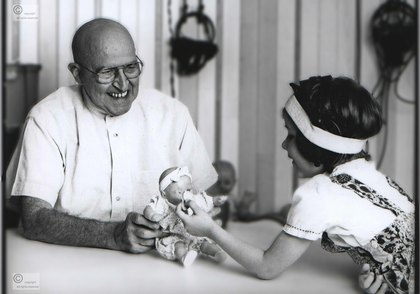
The Tomatis Method, or audio-psycho-phonological method, was conceived by Prof. Alfred Tomatis, otorhinolaryngologist and surgeon, born in Nice in 1920 to Italian parents. From 1945 onwards, Prof. Tomatis devoted his life — first in France, then abroad (Canada, the United States, Europe, where his theories and their applications are widely diffused) — to research on hearing, language and communication, thus bringing to light the relationship existing between ear, language and psyche.
Prof. Tomatis conducted his research first in the audiology laboratory of the French Air Force, and subsequently in his own centre of medical audiology. Analysing a sample of subjects who carried out their work in particularly noisy environments (jet-engine test benches, internal-combustion engine test benches, the riveting of metal plates in shipyards, the pneumatic hammer, and so on), he observed that the frequencies of the sounds that the ear could not perceive were the same that the voice could not emit.
Pursuing his research on a larger and more varied sample of subjects (among them singers as well), Tomatis deduced that this was a general characteristic, valid for any subject: a person is unable to reproduce with the voice those frequencies that he is unable to hear.
Subsequently, in the Laboratories of the Physiology of Functions at the Sorbonne, Professor Raoul Husson, an important French scholar of phonation and language, proved that every modification in the manner of hearing entails a modification in vocal emission, thus confirming Tomatis's discovery, which Husson christened the "Tomatis Effect": the phonatory apparatus emits the frequencies that the auditory system is able to perceive.
Beginning from this insight, Prof. Tomatis carried his research forward on a multidisciplinary plane, drawing upon studies of audiology, phonology and psychology. Thus was born the audio-psycho-phonological method, or Tomatis method, presented thereafter to the Academy of Sciences and to the Academy of Medicine of Paris (1957–1960).
What the Tomatis method is
The Tomatis method is a technique of sonic stimulation and a pedagogical intervention whose aim is to improve the functioning of the ear and, through it, verbal communication, the desire to communicate and to learn, the awareness of the bodily image, and audio-vocal and motor control.
The initial assessment is carried out by a listening therapist trained under the supervision of Prof. Alfred Tomatis or of one of his pupils.
The assessment comprises the listening test, a personal case history and, where indicated, a test of lateral dominance and graphic tests.
The functions of the ear
The human ear has the capacity to perform, normally, the following functions:
1) To perceive sounds
2) To process sounds without distortion
3) To distinguish high and low sounds (clear perception of sounds)
4) To perceive the spatial origin of sounds
5) To pay attention to the sounds one wishes to listen to and to avoid those one does not wish
to listen to (concentration)
6) To transmit energy to the brain through the nervous signal of sound (cortical recharge)
7) To integrate and co-ordinate the information coming from the movements of the muscles (vestibular function)
8) To maintain balance, to manage posture and the relationship with gravity
9) To stimulate and maintain neurovegetative balance, thanks to a branch of the vagus nerve that innervates a part of the middle ear
10) To control phonation
11) To control musical ability
These functions may be altered at any age by accidents, illnesses, emotional traumas, or poor acoustic habits. Through the use of the techniques developed by Dr Alfred Tomatis, it is possible to restore to the ear its essential efficiency, when the cause is not organic damage. Often what seems to be an organic or sensorineural difficulty is, at least in part, due to a poor functioning or a delayed development of the capacity for listening. From this poor use of the ear there may follow learning difficulties, lack of motivation, ready fatigue and, in certain cases, depression.
An ear that functions well is described as an ear that listens well — one that can in practice concentrate, among all the sounds of the audible range, upon those it wishes to listen to, and momentarily cut out those that do not interest it; it can perceive and analyse every part of the sound spectrum with the utmost speed and precision, and at the same time integrate the muscular movements of the whole body through its vestibular part.
A good ear has its counterpart in a voice of good quality and tonality. That is to say, a good voice reflects a good ear (the Tomatis Effect). We listen, speak, sing, play, read, write and learn with our ear.
The assessment and the listening test
The initial listening assessment identifies the functional capacities of the ear, diagnosing its strengths and weaknesses.
The listening test furnishes a comparison of the person's listening with an ideal, well-functioning ear, based upon the following requirements:
1) a threshold of audibility within the norm;
2) an open auditory selectivity for the analysis and comparison of sounds, so as to determine their
difference from one another and the direction of that difference (higher tones and lower tones);
3) a precise spatialisation of sounds for the identification of the direction of the sound source;
4) an ascending listening curve up to 3000–4000 Hz, with a stabilisation at this level and a
slight fall in the higher frequencies, so as to permit an easier discrimination among sounds;
5) a greater attention to the sounds one wishes to listen to than to the others;
6) uniformity of reception and an absence of distortion in the response curve of the ear;
7) a balance between bone conduction and air conduction in each ear and between the two ears;
8) a right audio-vocal dominance for a neurologically efficient control of the analysis of sound,
directly from the right ear to the language centre of the left hemisphere;
9) vestibular integration of muscular and sensory information for an effective motor control;
10) perception of high-frequency sounds to energise and recharge the brain.
The failure of one or more of these parameters produces a disharmonious perception, which translates into an unbalanced listening and, consequently, into poor learning and insecurity.
According to Tomatis, a listening problem that is not the result of an organic cause generally has an emotional origin, or proceeds from poor listening habits learned during childhood.
In thousands of cases studied, Dr Tomatis observed that many patients recounted situations in the first years of life in which they refused to accept certain stimuli coming from the environment, more particularly those of spoken language. Particular life situations led to the exclusion of information in order to protect oneself. To close oneself to sonic information is in fact possible. On the physiological level this is manifested by a relaxation of the muscles of the middle ear. This state of flaccidity, similar to the closing of the eyelids for the eye, considerably impedes the passage of sound, without the person becoming deaf on that account. Unfortunately it is not so easy for the ear, as it is for the eye, to open again. The muscles of the middle ear, having remained inactive for a long time, have lost their tonicity. Sounds are perceived imprecisely and, as a result, are analysed incorrectly: in other words, listening is impeded.
The Electronic Ear and the re-education programme
In order to help the human ear to establish or re-establish its full potential, Dr Tomatis developed a method of re-education of listening that uses music processed by a special apparatus called the Electronic Ear.
The re-education sessions, the progressive monitoring tests and the consultations are scheduled after the initial assessment (the audio-psycho-phonological assessment).
The programme, an intensive one, is divided as follows: a first part, generally of passive listening — that is, without audio-vocal exercises — lasting 30 hours, at about two to three hours a day. There follows a period of 4 to 10 weeks' interval, which serves the person in integrating the new models of listening; after which there follows a second phase of 20 hours, again at about two hours a day, in which the passive training is continued and, if the programme requires it, active exercises of reading aloud are carried out with the feedback of the Electronic Ear, together with particular exercises to attain audio-vocal control and to maintain it independently of the Electronic Ear. In the case of applications for singing or music, the person carries out exercises of singing or of instrumental performance with the feedback of the Electronic Ear. The length of the programme varies according to personal motivation and the degree of difficulty.
An average programme is articulated over 3 cycles: the first of 30 hours, the second of 20 hours and the third of 20 hours, with 4 to 10 weeks' interval between one cycle and the next. During the sessions, the person is sent — through a headset connected with the Electronic Ear — sounds (music, songs) filtered electronically so as to stimulate the focusing capacity of the ear. As the ear improves its selective power, the person manages to perceive sounds with less distortion and to analyse them with greater precision over the whole range of frequencies, from the fundamental sounds to the highest harmonics.
For an untrained ear, the fundamental frequency of a sound often masks its harmonic spectrum, and the person has difficulty in controlling the timbre of the voice (the ensemble of the highest harmonics). Consequently the voice remains flat, without modulation. By improving listening, the person has the opportunity to improve the quality, the fluidity, the modulation and the articulation of the voice, with great benefit to himself and to those who listen to him. The interest in the field of teaching and of work is vast. A voice that transmits energy and interest more readily invites listening.
Listening, voice and learning
The re-education of listening can be of great help to the pupil in scholastic difficulty, who — not perceiving sounds with sufficient clarity to reconstruct in real time the teacher's discourse — comes to tire after an hour of lesson, and to take more interest in the background noise present in the classroom than in the teacher's voice.
The training can help the musician who is unable to tune his own ear to the listening of the sound emitted by the instrument or by the voice, so as better to regulate the melody. By listening to the music filtered through the Electronic Ear, the muscles of the middle ear are trained to accommodate themselves to the highest harmonics of every sound source, thus gradually improving the timbre of the voice or of the instrument. Many singers and actors use the method to refine their own potential or to assimilate rapidly specific scripts and scores.
Posture and bodily image
The improved perceptual clarity leads to a better management of the bodily schema and of motor skills, which comes to bear upon the mastery of the instrument as well as of the voice.
Together with the ear, the whole body listens, and this occurs through bone perception. A person who listens well becomes more conscious of his own body, and during the audio-vocal training acquires a better listening posture. He develops a straight, but not rigid, back; the head takes its right distance from the shoulders, with neck and jaw relaxed; the chest opens to favour an ample respiration. Let us recall that Tomatis discovered that the manner of listening also conditions the manner in which we move and our posture, through the cochlea–vestibule relationship. One need only observe the different manner of standing and of moving of persons belonging to different linguistic groups. On this subject, read the section "Listening, Posture and Languages" on this site.
Cortical recharge
Tomatis studied the many functions of the human ear, discovering that it is primarily a system for producing cortical recharge and for favouring the electrical potential of the brain. Sound is transformed into a nervous stimulus by the cells of the Organ of Corti in the inner ear, sent to the cerebral cortex and thence to the whole organism, so as to dynamise and tone it.
Not all sounds produce this effect of recharge. Tomatis points out that, on the basilar membrane, the cells of Corti are more densely packed in the area responsive to high frequencies than in that responsive to low frequencies. For this reason, the high frequencies are more recharging than the low frequencies. Moreover, low-frequency sounds not only send energy to the brain insufficiently, but may also fatigue the person, inducing motor responses that absorb more energy than the ear manages to produce.
People who tend to be tired or depressed often have a flat, toneless voice, with a very poor content of high frequencies. The energising effect of music containing many high frequencies is of notable help also to persons who have suffered neurological damage or other physical problems, which often issue in a general lowering of energy.
The increased cortical recharge resulting from the listening of music rich in high frequencies translates into an increase of personal motivation, greater ease in work, a lowering of the level of fatigue, an increased sense of vitality, an improvement of attention, concentration and memory, and a lesser need for sleep, in the case where the person tends to compensate for the fall in energy by sleeping a great deal.
All these factors, but above all the increased capacity for concentration and memory, can considerably help the person to improve communication and learning.
Balance and the neurovegetative system
Tomatis demonstrated that the vestibular (balance) and cochlear (decoding of sounds) functions of the ear are unified in a single system. Anatomically, the vestibular nerve is present at every level of the spinal cord, and is from there directly connected with all the muscles of the body.
The stimulation of the ear through filtered music acts upon the bodily image, improving the awareness and the control of all the bodily segments. Moreover, the vestibular system controls the temporo-spatial awareness required in rhythm and in balance. Many sportsmen, above all skiers — some of them famous — integrate their training with listening sessions.
Tomatis explains how the vagus nerve — the auricular sensory branch of the pneumogastric nerve — regulates, through its ramifications, the pharynx and the various organs of the body. The auricular branch innervates the external surface of the tympanic cavity, thus forming a connection between our internal neurovegetative life and the external world. The person experiences a rebalancing of the neurovegetative system, which is reflected in an improvement of sleep and of appetite.
The listening of music filtered through the Electronic Ear improves the tension of the tympanic membrane, which, when it is taut, attenuates the amplitude of the vibration of the auricular sensory branch and consequently regulates the vagus nerve. This regulation is generally experienced by the person as a sensation of well-being, as a liberation from a heavy burden of ill-defined content. The person becomes more confident in his own possibilities, more aware of his own capacities, and more desirous of using his own voice in an assertive manner.
The audio-vocal sessions
The audio-vocal sessions (the active part) consist of repetitions of words and of texts, alternated with sessions of song and music (filtered and unfiltered). The words and the texts progressively lead the ear to listen over the entire range of harmonics of the sonic information. During the repetition of words and phrases, the person's voice, captured by a microphone, is modified by the Electronic Ear and returned to him through a special headset. The filters adapt the voice over the entire sound spectrum, spoken and musical, so as to give a high-quality control and a more efficient analysis of sounds.
Since the larynx can emit only the harmonics that the ear is able to perceive (the Tomatis Effect, demonstrated at the Sorbonne in 1957), the word, the phrase or the musical passage is emitted under a more precise control. When the ear listens well, the whole body is involved in the process. Learning is facilitated, and new models can be integrated and developed. The positive effects, in scholastic difficulties, are notable and documented.
In continuation of the audio-vocal programme, the person is advised to practise at home, every day, a phonatory exercise for at least half an hour. The exercise consists in a reading aloud, maintaining a good audio-vocal posture and holding the right hand near the mouth so as to reinforce the right audio-vocal dominance. In this way, the quality, the rhythm and the fluidity of the voice improve. Once the person has completed the programme, he is far more motivated to work and to learn, more capable of integrating new models with less difficulty.
While many researchers are beginning to investigate the importance of the ear in our life, the Tomatis Method offers a programme specially devised to work at the source of many functional, emotional and relational problems linked to a poor use of listening. A method surprisingly swift, which has a wide-ranging impact upon the health and well-being of the person.
In the other sections of the site you will find a development of the subjects indicated on this page.