Dyslexia and learning problems |
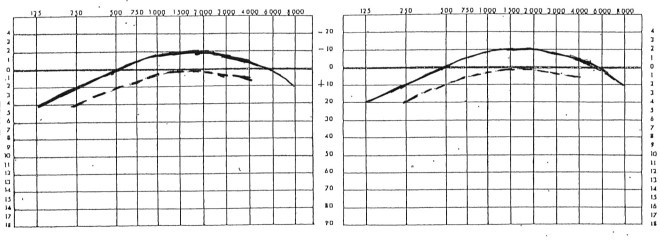
The capacity for listening allows the child to connect with teaching through the rapid decoding of the spoken chain and of writing. If the parameters that underlie listening are disturbed, the child's race towards the meaning of the world will be all uphill. Tomatis demonstrated that learning difficulties are, in the majority of cases, due to a poor functioning of the auditory sensor, which provokes disturbances in the decoding of sound. These perceptual distortions, by causing a difficult focusing of sounds, have repercussions in cascade upon reading, upon the graphic reproduction of sound (writing), as well as upon the capacity for attention and concentration. The ear, without becoming deaf, sends the sounds to the brain in a manner less clear and less balanced, creating distortions in the fine perception of language that come to undermine its management at the more complex levels, such as the comprehension of articulated concepts, writing, reading… For Tomatis, a child with attention problems, who shows a delay in language, in reading and in writing, or who presents behavioural problems, has suppressed or diminished his desire to listen. He no longer manages to express his thought clearly, to memorise correctly and to control his language. His listening test will present distortions in one or more of its parameters, as explained in the page dedicated to the measurement of listening. The Canadian colleague Paul Madaule, in an address at the conference "Listening and Learning" in Toronto in 1978, describes with an effective simile the pupil with listening difficulties. Imagine a person alone in a foreign country and obliged to communicate by means of a very poor linguistic baggage. He knows what he wishes to say, but manages to express it only in an incomplete manner. The words and the phrases through which he seeks to communicate remain approximate. The nuances and the finesses of language are not permitted him. When his interlocutor takes the floor, he will grasp only a part of his words; thinking he has understood, or tired of asking for repetition, he will respond accordingly, inducing deviations that will aggravate the confusion. The other will understand only what has been laboriously expressed, and not the true message. In the same way, he will respond to what he has understood, and not to what has been verbally said. […] Having then continually to search for the words of his own discourse, and to try to understand what is said by others, requires such an effort of attention and of concentration that he will very soon lose the thread of his own thought, coming to feel tired and worn out by the effort. A few episodes of this kind are sufficient to lower the motivation and to discourage the person, who may feel ill at ease among others […] and express the desire to return to his own country. Madaule proposes another example to clarify better the correspondence between the situation of the foreigner and that of the dyslexic. Introduce, between an interlocutor and yourself, a defective sensor; for example, a telephone receiver that is not conceived with the aim of transmitting the sound spectrum of the voice in its totality, but of reproducing the strict minimum necessary for the comprehension of the verbal information. In this situation the message is comprehensible as long as the vocabulary used is familiar to you; when it is a matter of a new word, ask your interlocutor to pronounce it letter by letter. Moreover, to avoid sonic confusions when spelling, telephone operators always add a known word whose initial letter corresponds to the one they are transmitting (A as in Ancona, B as in Bari, and so on). Paul Madaule continues: In the dyslexic-dysorthographic person there are no previous references that allow him to make the sonic correction of the message. Everything happens as if he had always listened through a telephone receiver. Every word, every letter is perceived and analysed by means of a deformed listening. Moreover, it should be specified that the ear of these children is habitually a far less faithful receiver than the telephone, since, unlike the latter, most of the sonic distortions are located at the frequency level of the verbal message. Indeed, the Listening Tests of dyslexics usually present threshold curves "in saw-tooth" or with troughs, with an auditory selectivity closed between 500 and 3000 hertz, the preferential zone of the reception of speech. The same listening tests reveal, moreover, a particularly unstable hearing, a further source of confusion in the search for indispensable points of reference for assimilating definitively new acquisitions. This allows one to understand better the difficulties these children encounter in permanently ridding themselves of their spelling errors, and the great diversity of these over time. […] Knowing language only through an unstable auditory perception, it remains foreign to the dyslexic child. He is like the foreigner in difficulty of communication, for not yet having known how to adapt his listening to the frequency level of the new language. […] His voice, murmuring in most cases, proves monotonous, […] his vocabulary is poor; the words and the intonations employed do not correspond to the situations described. The phrases are poorly constructed, the discourses confused, ill-structured and interspersed with numerous hesitations. It is several times necessary to have him repeat the words and the phrases in order to be able to understand them. Unlike the dyslexic, the foreigner in difficulty of communication, in spite of his unpleasant experience, remains sustained by an adult structure, the result of a series of experiences that have demonstrated to him his capacities in other situations. He is solid, sure of himself. On the contrary, the potentiality of the dyslexic has never been able to affirm itself; he lacks the confirmations of experience. He does not possess solid bases to prevent himself from doubting himself and from faltering. Moreover, the sensation of unease in a body-instrument that he does not know how to master is, in the dyslexic, almost constant. Language, the embodiment of the word, allows the encounter, the dialogue with oneself, the harmony of body and psyche. If what Tomatis calls the "structuring dynamic" of language is not neuronally crystallised, disharmony is created, an inner dissonance; a dissonance that imposes upon the child a universe of unease, a universe that he will project upon others and through whose filters he will deform the perception of the other. Dyslexics are often clumsy in their movements. They seem encumbered by their body, as by a garment too new or too tight. They do not know what to do with their limbs, in particular with their hands. Either rigid or slumped, their posture lacks naturalness and ease. This poor dialogue with their body explains in part the complexes regarding their physique that they develop in puberty. The dyslexic is "dyslexicated" into his very body. If the foreigner has difficulty in formulating them, his ideas remain nonetheless clear in his mind. The dyslexic, deprived of a linguistic sphere consolidated in a precise manner, has never had the possibility of formulating clearly what he thinks and feels. On the model of his ill-structured language, his ideas remain confused, buried within him, untranslatable. The dyslexic is "dyslexicated" into his very thought. Let us return once again to our foreigner and to his nostalgia. He can easily remedy his homesickness with a journey-flight towards his native land, thanks to a return ticket. The dyslexic suffers equally from the nostalgia of a lost elsewhere, where language was not necessary for communication. Flight, frequent in this type of young person, is its most eloquent signal. But for him, the return to the native country is in reality impossible; so he interiorises it and renders it credible in the imaginary of dreams, of reveries and of illusions. The diversion is a discreet and effective means of fleeing reality. Later, perhaps, he will seek this return ticket in alcohol, in drugs, in certain kinds of music, in certain marginal movements; in Kathmandu or in the Amazon. The merchants of dreams make their fortune with them. But every flight always concludes with a brutal return to reality. Of what does a dyslexic child think in the morning, when waking interrupts his dreams? Of school and of the poor marks that await him, of the return home in the evening with the poor marks to declare or to try to hide from disappointed and dissatisfied parents. The cycle of failures, home-school, "pollutes" his whole existence. You will understand, then, why it is often so difficult to get them out of bed in the morning. Like the prisoner in his cell, he counts the days that separate him from the next holidays-flight, so much fantasised about. When at last they arrive, the dream transforms itself again into reality, the reality of a universe dyslexic into his very leisure. His inner unease then transforms itself into boredom, into inertia, a ferment of anguish and of worries; worries about the new return to school that approaches irremediably day after day, and that will bring the burden of past accumulated failures: repeated years, changes of school, boarding school, and other things… One observes that in many cases the poor pupils are those who do not know how to enjoy themselves; this paradox has, for us, nothing astonishing. Like every psychically normal being, the dyslexic has need to communicate, but his difficulty in meeting the word, the image of the father, makes him refuse the linguistic mode of communication that is imposed upon him. Thus, the type of dialogue that he seeks can only be non-verbal — that is, empathic, affective, in a certain sense maternal. This dialogue took place in its fullness at the moment when mother and child were not yet two distinct entities, at the moment when, in the womb, they were one. The regressive attitude of the dyslexic, foreign to the paternal world of the symbology of language, is the effect of his nostalgia for the prenatal country long since lost. The dyslexic adolescent or adult is often in search of this primordial paradise of the mother-child dialogue through his sentimental adventures. As a rule, the relationships that he defines as true love conclude with disappointments that may assume, for him, dramatic dimensions. If his desire becomes reality, he rapidly finds himself tired and disappointed. These relationships often remain on a platonic level, so as not to ruin the imaginary, the illusion. The intrauterine memorisation, thanks to the filtered voice of the mother, as it is used in Audio-Psycho-Phonology, furnishes a concrete and direct therapeutic response to this nostalgia for the lost prenatal country; the nostalgia of the foreigner for the world of verbal communication and of its graphic transcription. What happens in daily life to the pupil in difficulty? The role of the ear in the development of language is fundamental for Tomatis. Language is fixed in our nervous system through acoustic perception. The more precise the perception, the more easily language will take root within us. If the perceptual clarity is precarious, the pupil may have difficulties in the rapid comprehension of phrases and of concepts. These difficulties often go unnoticed under a superficial observation, because the child manages to compensate for the perceptual deficit with an intellectual effort. An effort that will take energy and interest away from him in other spheres of daily life. In reading, it is a matter of already having clear in one's head the sound that the graphic sign represents, and the sound is clear if listening permits it. Otherwise, learning to read will be a hesitant proceeding, by trial and error, and studded with doubts. The inverse path occurs in writing, where the vestibular part of the ear is involved in managing the movements of the hand and of the arm. The cochlea, which analyses sounds, is in close relation with the vestibule, to help it programme and co-ordinate the movements. The organ of balance, then, with the management of the movements of all the muscles of the body, has its own important role in learning and in language, as much as the cochlea, and is complementary to it. Upon the vestibule depend all the movements of the body, including those of the phonatory apparatus in order to speak, those of the eye for reading and those of the hand for writing. It may happen, however, that the vestibule, excited excessively by the low frequencies, to which it is sensitive, may induce not only distraction, but also a continual tendency to movement, or hyperactivity. The frequencies of language, in a balanced listening, must be perceived with greater relative force with respect to the low frequencies, which carry the background noises. (See Figure 1)
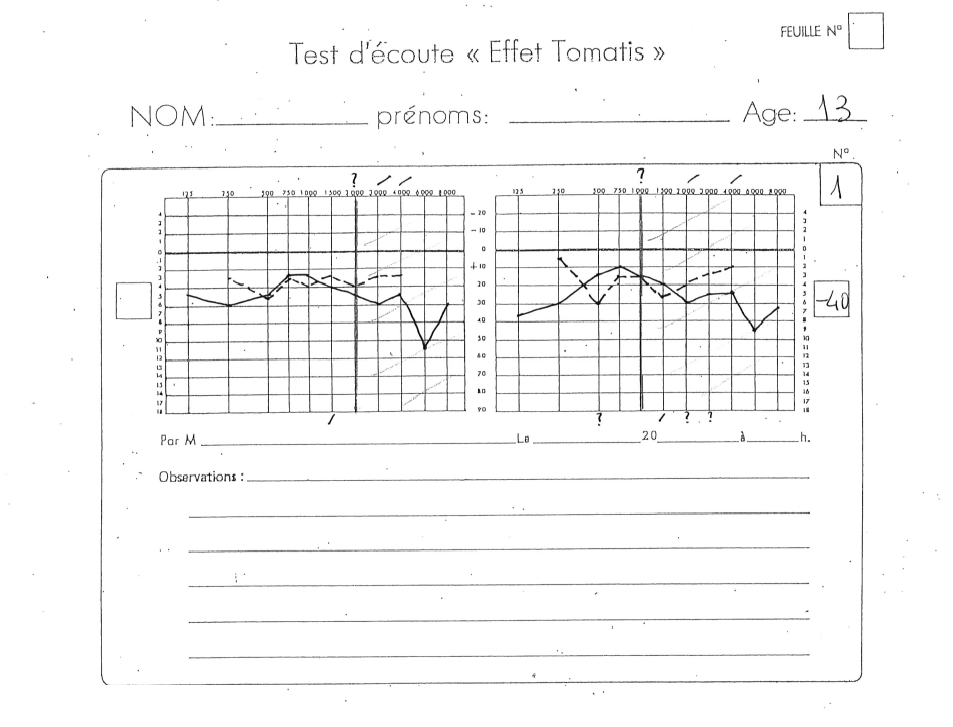
Figure 1. Ideal listening test If this is not so, it will be the latter that prevail in perception, and the child will be attentive, yes, but to the low sounds rather than to the teacher's voice, with a concomitant seeking of movement and of noise. See the test of the pupil whom we shall call Giovanni (figure 2): he presents several Tomatis parameters distorted with respect to a balanced listening. A greater sensitivity to the low sounds than to the zone of language (1000-3000 Hz), a bone curve that intertwines with and surpasses in sensitivity the air curve, predisposing to an excessive emotional sensitivity, a selectivity closed in the high sounds and in the zone of language, with a consequent difficulty of attention and concentration. Before the sessions with the Electronic Ear
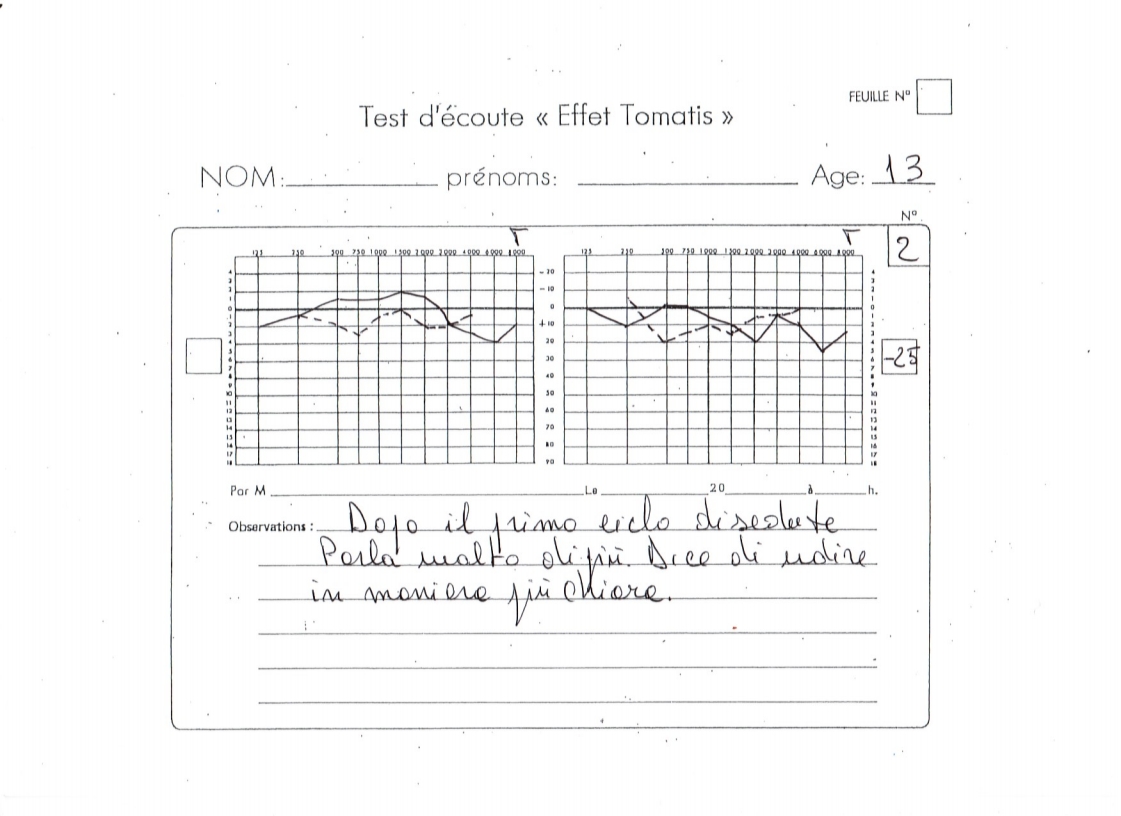
Figure 2. Listening test of an adolescent in scholastic difficulty: difficulty in concentrating and in understanding what he reads. Many ear infections as a child, and still now. A diagnosis of mild conductive hearing loss in the right ear (left-hand diagram), resolved after a cycle of audio-psycho-phonological sessions (see fig. 3). The thresholds of the air pathway are indicated by the continuous line, those of the bone pathway by the dotted line. After a cycle of sessions with the Electronic Ear
Figure 3. Listening test of the same adolescent after the cycle of sessions with the Electronic Ear. The analysis of sounds is improved. The curve of the air pathway has repositioned itself upon that of the bone pathway over most of the frequencies. The thresholds of the air pathway are indicated by the continuous line, those of the bone pathway by the dotted line. The high sounds are energising and favour attention and vigilance, while the low sounds, if in excess with respect to the rest of the frequencies, tire and take energy away from the nervous system. A perception that favours the low sounds may, moreover, often lead the child to perceive the voice of the teacher and of the other people in his environment as more aggressive than it is in reality, influencing his ways of comporting himself and his states of mind. The right ear, moreover, is the one that manages linguistic control, because it is connected more directly with the zone of the analysis of language situated in the left hemisphere. The left ear would furnish a sort of global control of the information. Some children, "to keep their distance" from the interlocutor, use the left ear to listen, lengthening the circuit of the passage of the signal and the times of comprehension and of response. The mother tongueReturning to our child with scholastic difficulties, he often presents, at the examination of listening, a poor analysis of the sounds of language, always accompanied by a similar difficulty in the high frequencies as well. Now, in order to be able to decipher and reproduce the living language, the child and the adult must not have great problems in differentiating the various tonalities, otherwise they risk confusing letters almost similar to one another, such as D and T, P and B, or hesitating between CR, DR and GR. Let us note in passing that it is the same mechanism that does not permit an adult, just beginning with a foreign language, to distinguish between almost similar words. In the first years of life, a difficulty in differentiating sounds similar to one another is normal, because the capacity for the analysis of sounds develops progressively, from birth up to 10-11 years of age, almost octave by octave. In the dyslexic, selectivity is totally perturbed. The blockage of the high sounds is a constant fact. Certain passbands that reside in other zones of the tonal scale seem like no man's lands, in which no analysis is possible. The child appears completely "colour-blind". If this difficulty persists, if the selectivity does not open as it should, in order to defend the child from something he experiences as aggressive, this may become a problem. A whole part of the subtle acoustic chain will be perturbed, and by reflex this will also occur in elocution, in writing and in reading. The child "hard of hearing" receives the message like a packet of sounds badly packed. He has moments of hesitation. Not recognising a word, he leans upon the context and manages as he can. The decoding will make him lose much time. If, in the meantime, another message is sent to him, he loses it, thus losing, little by little, the thread of the conversation. Communication becomes an obstacle race which, the obstacles accumulated one upon another, tires the child who runs towards the meaning of the world. Some children have placed, between the world and themselves, a curtain that lets the light pass but transforms objects into vague, indefinite forms or into deformed images. The ear has an analogous and equally discriminating capacity. Sounds are differentiated by intensity, frequency and relative value, the properties that characterise them. Hearing possesses an acute sense of directionality and, by localising sounds, helps the child to move and to orient himself in space. An ear closed to such a selectivity, and that has blunted the point of these very precise mechanisms, perceives language merely as a din of vague and imprecise meanings. Thus, with a small grain of sand in the ear, listening, as an opening towards the exterior, suffers a slight setback and progressively puts the listener out of phase with respect to the environment. A good listening supposes a good fluidity in the emission and in the reception of messages. The phonemes must be deciphered and recognised as they are enunciated. The Tomatis method, by helping the ear to perceive the linguistic sounds in a clearer and more harmonious manner, and by helping the pupil to lateralise to the right, has become a notable aid for scholastic problems. The learning difficulty, which may manifest itself in the form of problems of reading, of spelling, of calculation, of deficit of attention and of memory — once it is ascertained, through an audio-psycho-phonological assessment, that it is linked to a poor use of listening, as is often the case — may find in the method an excellent aid, often avoiding traumatic medicalisations and psychologisations. Some recent American research has confirmed the efficacy of the method in the treatment of learning disorders and of behavioural problems. A meta-analysis of this research was published by Tim Gilmor in the International Journal of Listening. The study demonstrated that the Tomatis method significantly improves linguistic, psychomotor and cognitive abilities; the capacity for personal and social adaptation, and the capacity for listening. The effects upon attention, concentration and memory are tangible. In attention deficit with hyperactivity, the listening test often reveals an exacerbation of the perception of the low frequencies, above all by the bone pathway. This leads the child to be much stimulated at the vestibular level, with a consequent irrepressible need to move, as if in the grip of a "mysterious force". Movement is often also a way of seeking a cortical stimulation to compensate for the poor perception of the high frequencies. But the stimulation that can arrive through the vestibule is ephemeral and soon tires the child. How many cases of children who, though having good hearing and good intelligence, do not manage to have a sufficient performance at school. Perhaps they are able to hold their attention well, or to carry out the exercises normally, during the first hour and a half, only for their level of interest, attention and concentration then to wane. Many teachers and parents wonder how this can happen. Tomatis's discoveries on the ear and the nervous system help us to give a logical and physiological explanation to the phenomenon. In the listening tests of these pupils, the first thing one detects is a difficult analysis of the high frequencies. The insufficient cortical recharge is generally compensated through sleep, which at times the child would wish to be longer, and a greater ingestion of sugars, refined and not. In the early hours of the morning, the child, returning from the rest of the night's sleep and from breakfast — which, with its sugars, has activated a certain energetic level — has the possibility of compensating for the deficit of recharge through the metabolic contribution and the recovery of sleep. Once the effect of these two factors has ended, he returns to his state of non-stimulation, with the consequent difficulty in concentrating. The opening of listening upon the high frequencies, the rebalancing of perception across the various frequencies, and an improvement of the right laterality are often sufficient to put back on track a pupil who, "for who knows what reason", in the words of the teacher, "has the ability, but does not apply himself, except at certain moments of the day". The vagus nerveTomatis tends to underline the important role that the vagus nerve plays in the state of mind of the pupil in learning difficulty. It holds, indeed, in its power — through the innervations that go from the eardrum to the middle ear, down through the larynx, the bronchi, the heart, the viscera, and so on — the whole field in which we may fix our somatisations: angina, the sensation of a ball that rises and falls, manifesting anxiety, the evanescent voice, the speech that is choked, the breath blocked by fear, palpitations, anorexias, bulimias, vesicular disturbances (gnawing one's gall), and so on, ending with the whole universe of vagal pathology, whose psychic resonance is so considerable. For Tomatis, the eardrum plays a fundamental role in the psycho-somatic and somato-psychic circuit of the vagal excitations, being the only organ giving onto the exterior that is innervated by this branch of the neurovegetative system. Hence the importance that sound, speech, the voice have upon the resonances of our internal response. When the eardrum manages to vibrate in response to high sounds, it is well taut, thus attenuating the neurovegetative fluctuations of the vagus. An excess of focusing on the low tones — therefore a less taut eardrum — without a good perception of the high tonalities, leads to an excessive vagal stimulation, favouring the neurovegetative manifestations connected with it. But how does this distortion of sensitivity, this closing of the ear, come about? Tomatis explains that the ear does not function like a simple receiver; it is linked to the brain, and therefore to the psyche, by means of subtle mechanisms. When we hear, the sound passes through the eardrum, which may be compared to the membrane of a drum. This tightens or loosens itself so as better to adapt to the surrounding acoustic impedances, thanks to the muscle of the hammer. From the eardrum onwards, according to Tomatis's conception, the sound is transmitted through the cranial box and makes the bony labyrinth vibrate in its totality; this vibration sets in motion the liquids found within the labyrinth, which permit the analysis of sounds. This labyrinth is not totally closed; it presents an orifice, and it is upon this that the stirrup comes to rest, which, with its muscle, forms a second system of regulation of sounds. By a play of pressures, according to need, it dampens or amplifies the liquid movements, thus permitting an optimal analysis of sounds. But it happens that this mechanism of adaptation of sounds — that is, the musculature of the middle ear — is unconsciously used as a mechanism of defence, a defence not only against sounds too violent that might damage the ear, but also simply to protect oneself from sonorities, from voices or from discourses that the person feels as a psychological aggression. One can thus, without stopping one's ears, refuse to hear anyone who disturbs us, frightens us or annoys us. The risk one runs is to do it habitually, which produces, on the motor plane, a relaxation of the two muscles that permit the regulation of sounds. Thus the ear, losing its capacity for accommodation, ends by generating a whole series of disturbances at the level of communication, and at times by becoming a screen that masks or deforms external reality, thus isolating the person. The work with the Electronic Ear, through the alternation of the two channels of amplification that invite the musculature of the middle ear to relax and to tense itself according to a precise temporal sequence, both by the bone pathway and by the air pathway, favours the setting back in motion of the capacity for accommodation and for the focusing of sounds. In practice, most of the audio-psycho-phonological re-education treatments consist of a first period of 30 hours of sessions distributed over about 10-15 days, followed by two periods of 20 hours each, interspersed with an integration pause that may vary from 3 to 8 weeks. The results
The progress observed is on the plane of concentration, memory, reading, spelling, writing and motivation. Bodily integration improves and personal energy is better channelled. The child realises himself and his potential, becoming more confident and autonomous. For further study, consult:Tomatis A. A., Educazione e Dislessia, Edizioni Omega, Torino, 1977 Campo C., Introduzione al Metodo Tomatis, Università degli Studi di Ferrara, 2002 Tomatis A. A., Le Difficoltà Scolastiche, Edizioni Ibis, Como-Pavia, 2011 Campo C., Difficoltà scolastiche e disturbi uditivi, Riza - Figli Felici, aprile 2013 |